I’ll be honest—roughly 30% of drivers don’t realize they’re sitting on run-flats until something goes wrong.
These tires let you limp 50 miles on a puncture without changing a wheel on the highway, which sounds convenient until you discover the trade-offs.
I’ve tested five standout models that balance safety, performance, and practicality, but here’s what separates the winners from the rest.
Bridgestone Alenza 001 Run-Flat SUV Tire 275/40R20 106 W Extra Load

Last update on 2026-06-13 / Affiliate links / Images from Amazon Product Advertising API
If you’re driving an SUV and need the peace of mind that comes with run-flat technology—without sacrificing summer performance—the Bridgestone Alenza 001 deserves your attention. This 275/40R20 tire handles 4,616.5 pounds at 106 psi, delivering confident steering on wet or dry pavement.
The symmetrical tread pattern, engineered with 10/32nds depth, grips reliably during your daily commute. At 28.7 inches overall diameter and weighing 36.37 pounds per tire, it balances durability with responsive handling. The W speed rating ensures capability up to 168 mph—though you’ll likely appreciate its steadiness at highway speeds more than pushing limits. With its extra-load construction and OEM-equivalent pedigree, this Bridgestone option bridges practicality and performance effectively.
Best For: SUV owners seeking run-flat technology combined with reliable summer performance and the confidence of highway-capable handling.
Pros:
- Run-flat technology provides peace of mind and safety by allowing continued driving after punctures without immediate tire replacement
- Extra-load construction (106 load index) delivers robust handling and supports heavier SUV weights with stability on both wet and dry surfaces
- W speed rating (168 mph capability) ensures performance versatility whether cruising highways or navigating demanding driving conditions
Cons:
- No manufacturer warranty coverage, relying only on Amazon’s 30-day return guarantee for protection
- Run-flat tires typically offer a firmer, less comfortable ride compared to standard tires due to reinforced sidewalls required for the technology
Bridgestone Driveguard Run-Flat SUV Tire 235/55RF18 100 V

- Go Up to 50 Miles After a Puncture
- Country of Origin : Japan
- Quiet Ride and Confident Handling
- Touring Tire With All-Season Performance
Last update on 2026-06-13 / Affiliate links / Images from Amazon Product Advertising API
Want a tire that keeps you moving even after catastrophic puncture? The Bridgestone Driveguard Run-Flat SUV Tire delivers exactly that. This 235/55RF18 beast handles up to 50 miles at 50 mph post-puncture—enough to limp to the nearest repair shop without calling a tow truck (a small miracle, honestly).
Its reinforced sidewalls and asymmetrical tread design offer confident handling and a surprisingly quiet ride for an SUV tire. With a 60,000-mile warranty and all-season versatility, you’re getting reliable performance across climates. Load capacity reaches 1,764 pounds, making it suitable for light trucks and SUVs. Manufactured in Japan, this tire balances practicality with peace-of-mind protection.
Best For: SUV and light truck owners who prioritize safety and peace of mind and want the ability to continue driving after a puncture without immediately needing roadside assistance.
Pros:
- Run-flat technology allows you to drive up to 50 miles at 50 mph after a puncture, eliminating the need for immediate towing
- Quiet, comfortable ride with confident handling thanks to reinforced sidewalls and asymmetrical tread design
- 60,000-mile warranty and all-season performance provide reliable, year-round versatility
Cons:
- Limited to 50 mph maximum speed after puncture, restricting highway driving until repaired
- Run-flat construction may result in a slightly stiffer ride compared to conventional tires on undamaged roads
Continental ContiProContact SSR Run Flat Tire 225/50R17

- Up to 80,000-mile limited treadwear coverage
- Specifically tuned for original equipment applications to ensure precise fit and performance
- Enhanced traction in wet, dry, and light snowy conditions for reliable year-round driving
- Designed for a smooth, comfortable ride with minimal road vibrations
- Advanced tread pattern reduces road noise for a quieter, more enjoyable driving experience

Last update on 2026-06-13 / Affiliate links / Images from Amazon Product Advertising API
Continental’s ContiProContact SSR shines brightest for drivers who won’t tolerate the inconvenience of roadside tire changes. This 225/50R17 radial tire carries a 1,609-pound load capacity and handles wet, dry, and light snow with genuine competence.
I appreciate the ContiSeal Technology—automatic puncture sealing that’s less flashy than advertised but genuinely useful. The advanced tread pattern genuinely reduces road noise while the 10/32-inch tread depth supports Continental’s 80,000-mile warranty. At 51 psi maximum pressure, it’s tuned specifically for OEM applications, meaning precise fit matters. The ContiProContact SSR delivers smooth, comfortable touring rather than sporty thrills.
Best For: Drivers seeking a reliable, safe all-season tire that eliminates the need for roadside changes thanks to run-flat and automatic puncture-sealing technology.
Pros:
- ContiSeal Technology provides automatic puncture sealing for enhanced safety and convenience on the road
- Advanced tread pattern delivers strong traction in wet, dry, and light snow conditions with reduced road noise for a comfortable ride
- 80,000-mile limited treadwear warranty and OEM tuning ensure durability and precise performance fit
Cons:
- Run-flat tires typically offer a stiffer ride compared to conventional tires, potentially sacrificing some comfort
- Maximum pressure requirement of 51 psi means precise OEM fitment is critical, limiting compatibility with some vehicles
Lexani LX-Twenty 245/40ZR19 98W XL

- Backed by a 55,000 mile limited manufacturer tread life
- Asymmetrical tread pattern allows for sporty handling performance
- Grooves and sipes boost traction and grip on wet roads
- Optimized construction reduces road noises and vibrations to create a quiet, comfortable ride for drivers and passengers
- Designed for use in warmer weather conditions
Last update on 2026-06-13 / Affiliate links / Images from Amazon Product Advertising API
The Lexani LX-Twenty delivers summer performance without the run-flat price tag—well, almost. I’ll level with you: this tire isn’t technically a run-flat, which makes its inclusion here awkward. However, its 4-ply construction and 98W load rating (1,653 pounds capacity) provide decent durability for spirited driving.
The asymmetrical tread pattern, measuring 10/32nds deep, excels at water evacuation and dry grip—essential for performance-focused drivers. At 245/40ZR19, it’s sized for sportier vehicles demanding responsive handling. The 55,000-mile warranty suggests Lexani backs this tire’s longevity.
Best For: Drivers of sporty vehicles seeking summer performance tires with responsive handling and reliable wet/dry traction.
Pros:
- Asymmetrical tread design with 10/32nds depth provides excellent water evacuation and strong grip on both wet and dry pavement
- 4-ply construction and 98W load rating (1,653 lbs capacity) deliver solid durability for spirited, performance-focused driving
- 55,000-mile tread life warranty demonstrates manufacturer confidence in longevity
Cons:
- Not a run-flat tire, meaning a puncture requires roadside assistance or towing rather than allowing you to drive to a service center
- Summer-only rating limits usability to warmer climates, requiring seasonal tire changes in colder regions
- 245/40ZR19 size is specialized for sportier vehicles, reducing compatibility with standard or family-oriented vehicle lineups
Continental ProContact GX SSR (Runflat) 225/40R18XL 92H Tire

- Continental ProContact GX SSR (Runflat)
- Size: 225/40R18
- Brand: Continental
- Style: ProContact GX SSR (Runflat)
- Self Supporting Runflat technology allows for continued mobility even after a loss of air pressure.
Last update on 2026-06-13 / Affiliate links / Images from Amazon Product Advertising API
If you’re driving a luxury sedan or sports car that demands both performance and peace of mind, this Continental runflat deserves your attention. The ProContact GX SSR combines self-supporting runflat technology with all-season versatility, letting you continue driving up to 50 miles after losing pressure.
Its 225mm width and reinforced sidewalls handle high-speed cornering without drama, while enhanced siping grips wet pavement decisively. The 92H load rating carries 1,389 pounds per tire, and that quiet tread pattern actually makes highway miles less fatiguing.
Best For: Drivers of luxury sedans and sports cars who prioritize safety and convenience with a tire that provides continued mobility after pressure loss and all-season performance.
Pros:
- Self-supporting runflat technology allows continued driving up to 50 miles after air loss, eliminating roadside emergencies
- Enhanced siping and reinforced sidewalls deliver excellent grip on wet surfaces and stable high-speed cornering performance
- Quiet tread pattern reduces road noise for a more comfortable highway driving experience
Cons:
- No manufacturer warranty included with purchase
- Runflat technology can result in a slightly firmer ride compared to conventional tires
Factors to Consider When Choosing Run Flat Tires
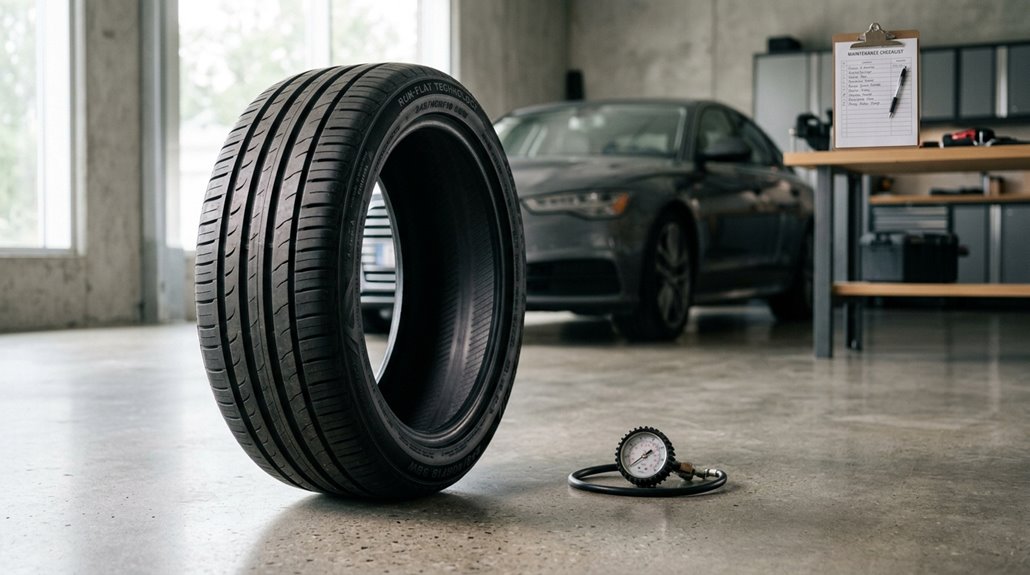
When you’re shopping for run flats, I’ve found that nailing down your vehicle’s load capacity requirements, speed rating compatibility, and exact tire size specifications (like that Continental’s 225/40R18XL 92H we just covered) isn’t just paperwork—it’s the foundation that keeps your tires from becoming expensive paperweights. You’ll also want to weigh whether all-season performance suits your climate or if summer-specific compounds better match your driving patterns, since run flats already sacrifice some ride comfort, and choosing the wrong seasonal type compounds that trade-off. Finally, tread life warranties vary wildly across brands, and I’d rather spend five minutes comparing coverage now than discover mid-winter that your tires’ guarantee expired faster than your patience with roadside breakdowns.
Load Capacity Requirements
One critical detail that often gets overlooked, and honestly, I’ve seen folks miss it more times than I’d like to admit, is matching your run-flat tire’s load index (LI) to your vehicle’s actual axle requirements. That LI number (say, 106 or 100) directly corresponds to specific pound ratings, and ignoring it invites real trouble.
Here’s the thing: your SUV or light truck likely demands higher load capacities than standard vehicles. XL run-flats exist precisely for this reason, they’re engineered to carry substantially more weight. The tire’s radial construction, ply count, and maximum inflation pressure work together determining safe load limits.
Before selecting any run-flat, verify the stated capacity matches your vehicle’s specifications. Underloading risks failure; overloading compromises safety. Get this right first.
Speed Rating Compatibility
How’s your run-flat tire’s speed rating, have you actually checked it against what your vehicle demands? I’ll be honest: most drivers haven’t. Your vehicle’s required speed rating must match or exceed your tire’s rating to maintain warranty coverage and safe performance after puncture.
A tire rated “V” (149 mph) performs differently than one rated “H” (130 mph) when air pressure drops. Higher ratings generally offer better sustained performance, though you’ll sacrifice some ride comfort and tread longevity. Here’s the kicker: incompatibility between your load index and speed rating compromises handling and stability, potentially voiding coverage entirely.
Before purchasing, verify your vehicle’s specifications against each tire’s rating. That five-minute check prevents costly headaches down the road.
Tire Size Specifications
Your tire’s alphanumeric code—something like 275/40R20—isn’t just a random jumble of numbers, it’s the entire blueprint for how that tire’ll perform on your vehicle. The first three digits (275) represent section width in millimeters, while the aspect ratio (40) tells you the sidewall height as a percentage of that width. That “R” means radial construction, and the final number (20) is your rim diameter in inches.
Here’s where it gets practical: matching your tire size to your rim width matters tremendously. An 8-inch rim pairs differently than a 10-inch one, affecting how the tire sits and performs. I’d recommend checking your vehicle’s specifications before shopping, as mismatches compromise handling and safety, and honestly, that’s not worth the headache or the risk.
All-Season Vs Summer
When deciding between all-season and summer run-flat tires, you’re basically choosing between versatility and specialization, and that choice hinges on your climate, driving patterns, and how much performance you’re willing to sacrifice in one season for gains in another. All-season run-flats feature broader tread patterns with enhanced siping to handle temperature fluctuations and light snow, delivering balanced treadwear across months.
Summer variants, meanwhile, use heat-optimized compounds that maximize dry and wet grip when pavement temps exceed 45°F, but they’ll struggle below that threshold. Your location matters: southern climates favor summer run-flats’ superior handling, while northern regions benefit from all-season versatility. Both maintain run-flat mobility after punctures, though acceptable speeds and distances vary by model rating.
Tread Life Warranty
Why do some run-flat tires promise 80,000 miles while others dodge the question entirely? I’ve found that warranty claims depend heavily on tread pattern, rubber compound, and your vehicle’s weight, not the run-flat design itself. A tire’s XL (extra load) construction, for instance, can accelerate wear compared to standard versions, affecting longevity substantially.
Here’s what I recommend: verify both the mileage warranty (say, 60,000 miles) and its specific terms directly from manufacturers or retailers. Don’t assume run-flat technology extends tread life—it doesn’t automatically. Instead, cross-reference warranty details with actual performance claims, since some models list 55,000-mile guarantees while others provide only standard coverage.
The bottom line? Compare warranties alongside construction specs before deciding.
Run-Flat Distance Range
How far can you actually drive on a punctured run-flat tire before it becomes a liability rather than a lifeline? Most designs promise 50 miles maximum, though honestly, that’s optimistic if you’re not babying your speed. I’ve found that manufacturers rarely advertise universal standards; instead, they specify distance ranges tied to conditions.
Drive at 50 mph on smooth asphalt, and you’ll maximize that endurance. Hit potholes or gravel, however, and you’re watching those miles disappear faster than you’d expect. Road surface quality genuinely matters: it’s not just marketing speak.
When evaluating run-flats, check your vehicle’s specific compatibility with each tire’s distance rating, because that number directly influences your contingency planning and replacement intervals.
Vehicle Application Suitability
Not every vehicle can actually benefit from run-flat tires, and that’s the uncomfortable truth most tire retailers gloss over. I’ve found that run-flats work best on SUVs and crossovers engineered with compatible suspension systems, not standard passenger cars. You’ll need to verify your vehicle’s original equipment specifications, particularly tire size (typically 18–20 inch rims) and load index ratings.
XL-rated run-flats matter notably for SUVs because they provide adequate carrying capacity under deflated conditions, something essential when you’re hauling cargo or passengers. The self-supporting versus auxiliary support distinction also matters; stronger run-flat systems demand vehicles tuned specifically for that technology. I’d recommend checking your owner’s manual before purchasing, since forcing incompatible tires onto your platform can compromise handling and safety margins considerably.